Thursday, June 25, 2026

Padua, Vicenza and Verona

After our 3 days in Venice, we have spent a few days in each of three northern Italian cities —  Padua, Vicenza and Verona. Although they are quite close to each other they are surprisingly different. The main obstacle to our full enjoyment has been the searing heat. The whole region, and apparently much of the rest of Europe is having an exceptionally early and intense heatwave, with daily highs of 95 - 102 F (35 - 39 C), and occasional thunderstorms. We have been undeterred, fortified with plentiful cold water and daily indulgence in gelato.

We have been staying in various small comfortable B&B’s — a “residenzia”, an “Elite BB”, a “relais”, and an “Albergo” — all with excellent breakfast, comfortable rooms (with good air conditioning) and friendly landladies with a range of English skills. It was quite noticeable that once we were out of Venice, the locals were much more reluctant to try their English and we struggled with rusty and never very good Italian.

Italy is much changed from what we remember from trips here as children in the 1960s. Tap water is safe to drink, and excellent; hotels and restaurants are air-conditioned; cities are quiet with far fewer cars and honking horns; few people are smoking in the streets and the streets are immaculately clean, with battery-powered cleaning machines vacuuming and brushing any trash or dust.

Padua has a very old university founded in 1222 — Galileo taught there. Even though it is summer, there were many young people on bicycles and many inexpensive eateries. The city streets are small and there are few cars. We really liked the shaded arcades over the sidewalks wherever we walked. Padua is a big pilgrimage site with the Basilica of St Anthony of Padua as the main attraction. He is one of the most popular Catholic saints — he is asked for help finding lost things. The locals just call him “Santo” — he is the only one that counts. His feast day was June 13, so we just missed it, though there were still large crowds queuing up to visit his tomb, and people leaving white flowers at his statue. His enormous basilica dominates the south part of the town. 

One other site, not to be missed, but that we had never heard of, is the Chapel of the Scrovegni. This is a small chapel that allows only 25 people to visit for only 15 minutes at a time. Before entering, the select 25 must sit in a small sealed chamber for 15 minutes while the air is purified and dehumidified. All this is essential to protect the wonderful Giotto frescoes, painted in 1305. The interior of the chapel forms a picture book of the story of Jesus, with each of the 38 panels depicting a scene from the story — vital in an era when few could read. There were some other interesting touches; small medallions of the 7 deadly sins on one side of the aisle with their corresponding virtues on the other. It is amazing that the Chapel ever survived. Apparently the whole place was nearly “deconstructed” and the frescoes shipped off to the British Museum in the 19th century (like the Parthenon marbles!)

On a more secular note, it is so interesting to see that each of the towns we have visited has at least one street that is lined by the most exclusive and expensive shops selling beautifully designed and displayed men’s suits, women’s clothing, gloves, shoes and other high end items. Italians have a great sense of style…

Two other Padua notes: It is the home of Aperol, the ubiquitous orange aperitif that is served as an Aperol spritz in every cafe. It is also the city where Shakespeare set “The Taming of the Shrew”. He loved these north Italian towns!

Vicenza was our next destination — only 25 minutes by train from Padua, but a totally different ambience. It is the birthplace and main workplace of Palladio, the Renaissance architect who defined the neoclassical style that spread throughout Europe. It seemed like every building in the town was designed by Palladio and his acolytes and they give the town a very stately look and feel. We spent the first day walking around, always looking up at pillars, windows and cornices. We visited several interesting galleries housed in Palladian palazzos, including a really interesting architecture museum (We never thought we would write those words).

Unfortunately, we discovered that most of the buildings in the town we might have wanted to visit were closed on Mondays,  so despite the heat, we walked over 6 miles out of town to visit an interesting villa, gardens and a chapel. The Villa Valmarana was a beautiful building “with dwarves” (ai nani), again in Palladian style and with murals in every room painted by Tiepolo, and in beautiful condition. The dwarves are 17 fascinating stone statues set on the wall surrounding the villa. Tiepolo and his son also painted many imaginative and stylish frescoes in other buildings in the villa complex, which we enjoyed looking at and finding interesting little details. The villa had a lovely, but very steep garden, with a variety of trees, colorful flowers, herbs and beautiful views over the valley.

Our next stop was the chapel on Monte Berico, high above the city and accessed via a long, steep arched portico. The chapel was not much to look at, but the views of the city were wonderful. With the city below, we could see the southern edge of the Alps in the distance and the lush northern Italian plain stretching east towards Venice and west towards Verona.

During our walk we had come across the central square of Vicenza being prepared for a huge “Viva Verdi” concert. We discovered admission was free but you had to send an email to the city administration asking for tickets. Google Translate to the rescue; and a few minutes later we had a very charming and personal response saying that there were no tickets available but if we just turn up there would be space. Then we found that the restaurant we were planning to eat at was right on the square, and they had a table that gave us front-row seats, and we listened to the orchestra and singers warming up. So we had a delightful meal to the sounds of Verdi, then a fascinating glimpse of the parade of locals kitted out in elaborate and glamorous evening dress and spike heels arriving for the concert. After some technical issues the concert got started a bit late. The weather was looking threatening but we heard some fine choruses, solos and orchestral pieces, before the wind rose, rain came down, and giant cafe umbrellas were blowing over, scattering glassware. The audience started to scatter too, as did we, and we got back to our hotel just before the heavens opened, with thunder and lightning. It was dramatic, and we felt sorry that the weather spoiled the huge effort staged by the city, but we did experience some lovely music. 

Then, the next morning…on to Verona. The immediate impression was a bigger city;  busier, more tourists, more traffic, more to catch the eye in every direction. Shakespeare definitely contributed to the atmosphere, with “Romeo and Juliet” and “Two Gentlemen of Verona”. We are strenuously avoiding the “Juliet Balcony”, which apparently was only added to the house in the 1800’s, but is a serious revenue generator for the city. The huge Roman arena is the venue for the Verona Opera Festival, which has just started and features all the Italian favorites. The area round the arena was full of enormous pieces of scenery, including an elephant (for “Aida”) and a Moulin Rouge (for “La Boheme”) We considered going to a performance of Aida on Thursday, but it won’t start until 9:30 PM, runs for over 3 hours and we have an early start on Friday to catch our plane from Milan to Philadelphia — too bad.

We spent our first morning in Verona visiting some interesting churches — some built on top of older churches, the very oldest being 4th century Roman constructions. Several notable local saints were martyrs, killed by the Romans before the Romans converted to Christianity. Saint Fermo was killed in 304 with a “fishbone” and there are a couple of large fishbone “sculptures” in Verona to commemorate. A very early subterranean Romanesque church dedicated to St Fermo was a cool and fascinating place to visit with fine ancient frescoes and quiet simplicity. On top of the old church, a “new” church was built in the 13th century. It has a huge impressive wooden ceiling, like an upturned boat, with images of 416 saints, mostly unidentified. 

Other destinations included Sant’Anastasia and The Duomo of Verona, and in the afternoon a visit to a museum of Roman inscriptions. A Veronese nobleman, the Marquis Maffei, was obsessive about collecting stones with Greek and Roman inscriptions — it was part of the ethos of the Renaissance. He also collected stones with forged Latin inscriptions to expose the 16th century trade in fakes! Our final stop of the day was a huge and ancient red-brick fortress, on the banks of the fast-flowing Adige river, and now housing an amazing collection of ancient, mostly religious art.

Today is our last day in Verona and tomorrow we fly to Philadelphia from Milan. We have squeezed in a few more tourist destinations — a fine classical-style garden and a modern art galley, more as a respite from the heat than for a genuine love of the art. This afternoon — our last art gallery; the Palazzo Maffei, and one of the best collections and layouts we have ever seen. A spiral staircase led up to the roof with terrific views of Verona to end our wanderings. Tomorrow an early train to Milan.

Here are a few pictures, again in reverse order :-(  

Giusti Garden, Verona

Cathedral Cloister, with robot lawnmower, Verona

San Fermo Church wooden ceiling, Verona

Dante statue, Verona

Concert with rain clouds, Vicenza

Gelato, Vicenza

Arcade to chapel, Vicenza

Dwarves statues, Vicenza

Villa Valmarana “AI Nani”, Vicenza

Train from Padua to Vicenza

Giotto “Justice” Scrovegni Chapel, Padua


St Anthony of Padua Basilica

Central Market, Padua


Friday, June 19, 2026

Italy In June

After a wonderful week in Corfu with 15 members of our family, Lin and I took a ferry from Corfu to Igoumenitsa on the Greek mainland then a 20 hour voyage on an Italian ferry from Greece to Ancona on the Adriatic coast of Italy. The ferry was quite new and comfortable — we had a cabin with a shower. Most of the other passengers were truck drivers…all tough looking guys from Bulgaria, Serbia, Germany, Poland, etc., who slept on the benches in the ship’s bar. 

Ancona, itself, is primarily a port though it has a few interesting corners. It was very seriously damaged during WWII by American bombing, as it was an important port when Italy was occupied by the Germans. Our hotel had obviously been THE place to stay — the Grand Hotel Palace — with 20 foot ceilings and elaborate plaster cornices. It was wonderfully comfortable and after wandering round looking at a few interesting churches, we stopped at a nice little restaurant in the main square for dinner. We were entertained by the owner “attacking” the marauding pigeons with a high powered water pistol. After a quiet, non-rocking and rolling night, we enjoyed a delicious breakfast buffet where we bumped into a group of young American women working in Ancona this summer; one of them had gone to the same high school in Dublin, Ohio as grandchildren Leah and Evan.

Our next step was northwards on wonderful Italian high-speed trains to Venice. We sped at 120 mph through coastal towns, some of which I remember visiting in 1962 when my mother and 4 children including me visited Italy in a Fiat 500 Giardinera. We were so impressed by the immaculate farms and towns of the Po Valley, and we even crossed the Rubicon (though going in the opposite direction to Julius Caesar).

WOW! Venice is a completely weird and crazy city, different from anything we have ever seen — water everywhere and no cars. Directly from the station, we struggled with waterbus timetables, balky ticket machines and nervous tourists, but eventually found the right waterbus to the right “busstop” and then walked dragging our suitcases over hump-backed bridges to a charming little B&B for the next three nights. 

So much has been written about Venice that there is little more to say. It is a crazy patchwork of tiny streets, alleys, passageways and bridges, interlaced with canals of many sizes. The buildings go from vast grand palaces to tiny houses squeezed into oddly shaped gaps. Some are immaculately maintained, others are so dilapidated it is surprising they are still standing. There are virtually no straight lines. We were pleasantly surprised, after hearing horror stories, to find that the streets were relatively quiet and free of visitors. Even St Mark’s Square — the focus of much tourist activity — was almost empty. Our first evening we spent wandering round, dazed by the sights and sounds, and being regaled by gondoliers hoping for our custom. Their beautiful sleek black and elaborately decorated boats were everywhere.

With so much to see, what to do? We discovered almost by accident that the Venice Biennale of Art is taking place this summer so every church, palace and public space was given over to art exhibits. There are also two huge venues in the southeast of the city where the major exhibits are located. Our first day we visited the Peggy Guggenheim Museum (remarkable private collection of early 20th century art, and a lovely garden), a serendipitously discovered and fascinating exhibition on the history of maps (sponsored by Saudi Arabia!) in an old convent, and the mindbogglingly enormous Doges’ Palace, with the biggest oil paintings anyone has ever seen, mostly extolling the virtues of various Doges, who seemed to be portrayed as only slightly less important than Jesus and the saints. We were also amused by the “complaints letterbox” where ordinary citizens could post anonymous complaints about the behaviour of Venetian officials.

As we left the Doges’ Palace in the evening there was something going on with large numbers of police holding back the crowds to keep us away from some VIPs in expensive suits waking through the St Mark’s Square. Later at dinner on a small canal, our restaurant was occupied by 25 riot police, with helmets and shields who all seemed to be enjoying a nice Venetian meal. Apparently the mayor of Venice needs a huge protective force wherever he goes. He is so unpopular because he has introduced a “tourist fee” of 5 Euros a day for everyone who visits Venice on Friday to Monday and it is making it more difficult for locals to make a living as fewer tourists are visiting. 

The next day, we decided to go for it, and visit the Venice Biennale in the old Venice Arsenal. This turned into an experience of sensory overload — an enormous dark warehouse with massive colorful and cryptic modern artworks in every imaginable medium. We wandered for hours trying to make sense of it all. The artists, from all over the world, but particularly from Africa, SE Asia and South America had provided descriptions of their intent and motivations, but frankly their explanations often left us even more baffled. We probably need to abandon our western, rationalist, logical mental habits to get on the right wavelength, or perhaps no wavelength at all. 

After we had visited the central exhibit, it was on to somewhat smaller installations sponsored by various countries. We also moved to the other main site, where the Biennale has been held for more than a century.

Some of the country exhibits were playful and fun. We were particularly amused by the Japanese pavilion that was overrun by hundreds of well dressed baby dolls in sunglasses. Visitors were encouraged to walk around the exhibit holding a “baby” and doing various babycare activities, like feeding and changing. There were precocious babies playing on the roof, climbing ropes and watching TV. It all had something to do with the falling birth rate in Japan.

The American Pavilion was quite baffling. An artist called Alma Allen had created about 30 amorphous sculptures in various materials; all were called “untitled” and there was no artist’s statement. Not sure what that says about the USA!

A Belgian artist had collected over 50,000 postcards from junk shops and thrift shops and classified them into various themes by subject, color, type, country and pasted them on walls in columns 40 postcards high. We stared for ages from close up and from a distance. It was like a treasure hunt crossed with a pointillist painting.

After 6+ hours we staggered back to our hotel, exhausted and slept like logs that night.

Today we are in Padua, reached after a short train ride from Venice. On the waterbus from our hotel to the station we met someone who used to live in Narberth and when to school at Lower Merion High School, where Rob and Mark went. He was somewhat younger than them, though, traveling with wife, 3 very young kids and mother-in-law.

What a contrast Padua is… a quiet old town with many nice squares and old cobbled streets. As we walked down one little street we heard a wonderful operatic tenor voice streaming out a window of the music school — a very Italian moment. It is hot (93 degrees F), so we treated ourselves to some delicious gelato in a cool little air-conditioned store in an arcade. 

We are looking forward to one more week of traveling through northern Italy, before flying back to Philadelphia next Saturday.

Here are some pictures — in reverse chronological order.

Japanese Babies

Belgian postcards from a distance

Belgian postcard closeup

Scorpion seal made of rubber with blood?

Gigantic woolen things

Dinner with riot police

Venetian washing day

Gondola ride

St Mark’s cathedral

Ancona sunset


Sunday, March 30, 2025

Back in Brazil, Part 3 Olinda - Fernando de Noronha, March 24 - 31, 2025

 This is the final leg of our 3-week trip to northeast Brazil, and the final installment of this blog.

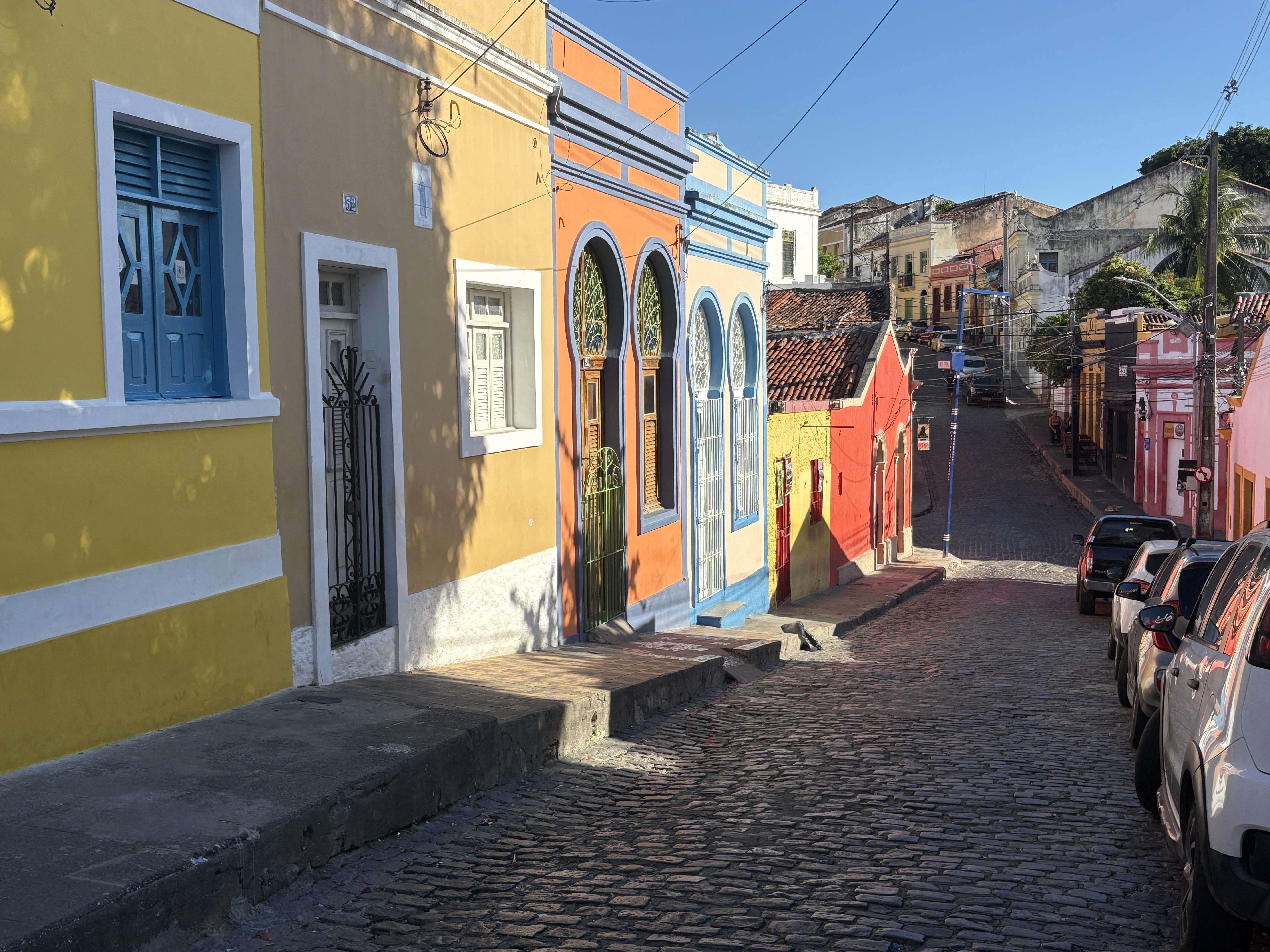
We spent four nights in a small, very old pousada in Olinda, a beautiful, hilly city next to Recife, the huge 3.7 million-person capital of the state of Pernambuco. What a contrast there is between the two places, although they are so close to each other. Olinda has small twisty, cobbled streets and steps, and the houses are extravagantly painted in wild colors, often with dramatic murals. There are dozens of old churches, many in a state of near collapse or terminal mildew. There is also a very lively market with many interesting art and craft stalls, woodcarvings and lace-making, as well as the inevitable plethora of tapioca stands. Olinda is very green, with fruit trees and vines growing everywhere, even out of cracks in the roofs of buildings. 

We spent our first day exploring Olinda, and visited one notable 16th century Franciscan monastery, its walls covered with blue Portuguese tiles depicting the life of St Francis, including parrots, peacocks and monkeys. St Francis loved animals according to legend, but we are pretty sure he never met a parrot.

We regularly did our walking and sightseeing in the mornings after a substantial breakfast and before the heat became too brutal. By noon we were ready to retire to our air-conditioned room for a few hours, before heading out for an evening stroll, and sometimes a bowl of açaí sorbet. 

Despite the fact that Olinda is a well-known and picturesque tourist destination we rarely ran across other non-Brazilian visitors, and even Brazilians were thin on the ground. Apparently we were visiting in the post-carnival low season. This led to the problem of finding an open restaurant in the evening — most were closed or only open at weekends. However we did find some excellent, quiet places to enjoy delicious Brazilian food. Our favorite was a whole small pumpkin filled with a “soup” of shrimps, coconut milk and delicious if unidentified spices.

Feeling quite adventurous one morning, we took a local bus into Recife to visit some of the sights. We were lucky to encounter a young passenger who was adept with Google Translate and directed us to the stop to get off and change to another bus line. Our encounters with young Brazilians have been very positive and rewarding.

Recife is a big, messy city with some beautiful modern buildings, but on the whole it was a disappointment — trashy, grungy and grubby. We visited a couple of the top tourist attractions in the old town but were less than impressed.

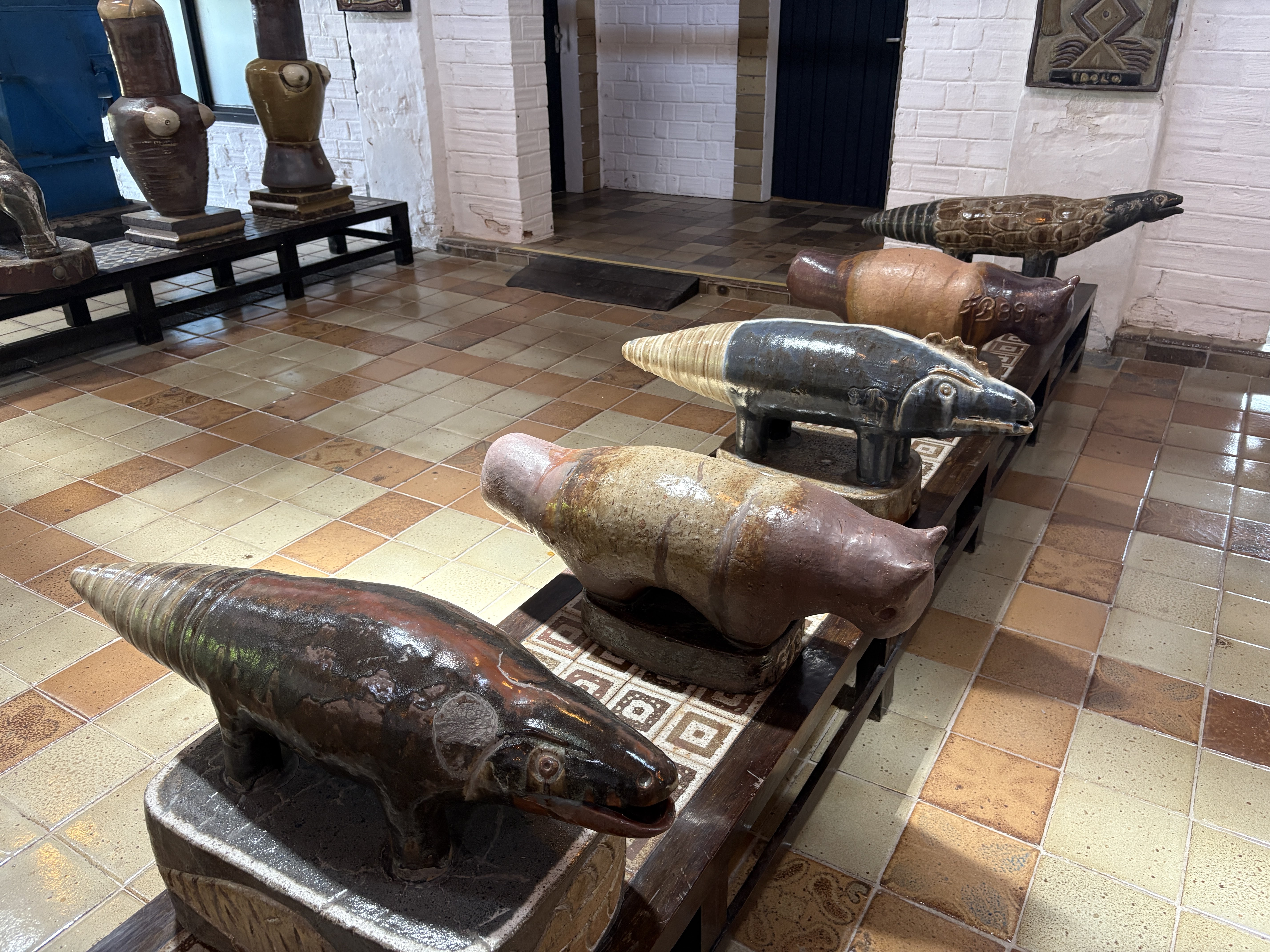
Our final Olinda day involved a long Uber ride into a remote area of rain forest in the Recife suburbs, where we visited one of the most amazing art museums we have ever seen — the Oficina Cerâmica of Francisco Brennand. He was a reclusive and prolific ceramicist who worked mostly in the 1960 - 90 period. He inherited a ceramic factory from his father, and spent his life creating and displaying inside and outside thousands of huge, complex and weird ceramic sculptures and structures, based on mythology, imaginary animals, abstract shapes, and artistic interpretations. We won’t try to describe any more — there are a few photos below. The museum significantly rehabilitated our impression of Recife.

Our last few hours in Olinda were eventful, with a series of violent thunderstorms that caused the hotel roof to leak, and flooded the streets on the way to the airport. A misunderstanding about plane times and airport gates caused us to miss our flight to Fernando de Noronha, but we were able to rebook and arrived on this small, remote island only a few hours late. Fernando is about 200 miles off the coast of Brazil, and is the tip of a huge submerged volcano. As a result the coast is black volcanic rock interspersed with beautiful white-sand beaches and tall rocky pinnacles. Most of the island and nearly all the surrounding reefs and islets are part of a national park, so much of it is inaccessible.

We are here for 5 nights, and are staying at a beautiful little pousada surrounded by tropical vegetation. There is only one road across the island served by a regular and free bus service, so we are becoming adept at getting around. It would be hard to get lost in such a small place, with only 3,000 regular inhabitants. We are so far east that we have only a 2 hour time difference with London, and 3 hours in the other direction from Philadelphia. 

Charles Darwin visited on his famous Beagle voyage and was disappointed in the lack of interesting bird life. However, the cliffs and outcrops are alive with boobies, noddies, terns and beautiful tropicbirds. This is a wonderful place to relax in the shade with a pair of binoculars. We are being quite careful not to get exposed to too much sun, as we are only 4 degrees south of the Equator. We have been in the sea up to our knees, but no further — the surf is huge and dangerous. Also, Noronha is famous as a breeding place for many species of sharks. We also came across multiple nests of turtle eggs waiting for the full moon to hatch. Because the island is so isolated and small, everything is imported, except for fish, and we have been enjoying dinners of various local fish dishes .

This is a perfect place to end our holiday — fascinating, relaxing and friendly.

Olinda houses

View from our hotel window

More Olinda houses

Pumpkin with shrimps — Jerimum

 
Francisco Brennand ceramics

Brennand fantastic animals

Courtyard — it’s ALL ceramic

Fernando de Noronha

Sand, rock, surf

Empty beach with black rocks

Brazil’s favorite snack — tapioca

Another reason to stay out of the water

Tuesday, March 25, 2025

Back in Brazil, Part 2 Salvador - Olinda, March 19 - 24, 2025

We spent 5 nights in an elegant remodeled colonial hotel in Salvador, dined in excellent local restaurants, then headed northeast. Our ultimate objective was the town of Olinda, a beautiful old town close to Brazil’s third largest city, Recife. The distance between Salvador and Recife is about 600 miles (c 900 kms) with many interesting places in between, so, despite many warnings about crazy Brazilian drivers and hazardous roads, we rented a car, and relied on Google maps to get us where we wanted to go.

Salvador Shopping Our first adventure was finding the rental car. Our Uber dropped us off at the front door a massive new multistorey shopping center with a bewildering number of elevators, escalators and ramps. We got completely lost, but luckily a very nice young man who spoke no English but was adept with Google Translate ordered up a golf cart to rescue us and drop us at the rental office — another example of the kindness of Brazilians to the hapless elderly.

Brazilian Drivers really did not live up to their reputation. Most are polite and considerate drivers, obey the traffic signals and road signs, and keep to their lanes, though there are exceptions. For a country that is still developing, there are very few old cars. Everyone is driving newish Korean, Japanese, and European models mostly made in Brazil.

Roads are mostly good. The main hazard is speed-bumps, called lombadas. Even the main 4-lane highway has frequent speed bumps in most towns. Some are signed and painted, others are not, so it’s impossible not to hit a few of them pretty hard, putting a strain on the car’s suspension and tires — and on our nerves, especially when the jolt switched on the wipers and the radio.

Agriculture. Long stretches of the road traversed vast sugar cane plantations, mostly grown for conversion to alcohol fuel — though the Brazilians do love their sweet cakes and candies, too. The other crop we saw in many places was cassava, a rather pretty plant about 3 feet tall with huge underground tubers used for making tapioca, one of the staples of NE Brazilian cooking. 

Monkey bridges The road passed through some long stretches of uncultivated forest, with regular rope suspension bridges designed for monkeys to cross over the road. We did not see any monkeys on their bridges, but we did come across some at our first stop.

Aracaju We divided our trip into 3 chunks of roughly 300 kms each, which led us first to the city of Aracaju, capital of Brazil’s smallest state, Sergipe. Aracaju is a not very attractive city, but just south of it are some wonderful beaches and pretty beach towns. The sand dunes between our hotel and the beach were home to interesting wildlife, including burrowing owls and demented looking guirá cuckoos. We visited the old market in the center of town which sold vast quantities of colorful Brazilian fruits, many of which have no recognizable English names and were completely unknown to us. Little wild marmosets take advantage of generous stall owners who feed them pieces of banana and other fruits. They are very cute. 

Aracaju is named after the caju = cashew tree which grows there in abundance. The fruit is peculiar — an orange-yellow pear-shaped fruit that is used to make an acidic juice and fruit sauces. Below the fruit hangs a small greenish comma-shaped thing, which is the shell of the cashew nut. The shell is poisonous and tricky to open, but inside is the deliciously tasty cashew nut that we and Brazilians eat in large quantities. 

After two nights in Aracaju, we headed towards the next big town, Maceio, in the neighboring state of Alagoas. Google Maps let us down, and led us onto increasingly narrow, twisty roads, through some very pretty little villages, until we were driving on dirt roads through sugar cane fields and eventually came to a dead end. We knew where north was and eventually managed to find a road that led us to our next destination, the small coastal village of Barra San Miguel. Our hotel was on the beach, but there were no surfers or sunbathers in sight. The fabulous white-sand beach was mostly empty for miles in both directions.

There is not much going on in Barra San Miguel, but our hotel was comfortable, and there was an interesting small town nearby called Marechal Deodoro, known to Brazilians as the birthplace of the first President of Brazil. Unlike George Washington, he was not an admirable figure, so is little celebrated. The town was picturesque, with fishermen landing their catch and dozens of great white egrets waiting for their share. There was a huge convent and church, which the tiny guardian unlocked and allowed us to visit.

We did not visit the town of Maceio itself, which is mostly modern buildings, and is famous as the home of one of Brazil’s allegedly most corrupt presidents, who was convicted and jailed for taking millions of dollars worth of bribes.

Our final day of driving took us from Barra to Recife where we dropped off our car, with some relief, and we are now spending 4 nights in beautiful Olinda.

Brazilian food We are not big meat eaters, though most Brazilian menus feature large amounts of grilled beef. However, there is an abundance of wonderful fresh fruit at breakfast — nearly always 5 or 6 varieties — and many interesting baked goods. At our hotel in Barra, they had an open wood fire to keep the coffee and pastries warm, despite the 90 degree heat. 

Another staple of breakfast is tapioca. This is not the easily digestible pudding that was a feature of our British childhoods. A tapioca is a small white pancake of cassava flour, toasted in a frying pan then loaded with sweet or savory fillings and folded like a taco. This is such a popular snack that there are at least 20 tapioca stands on the main square of Olinda. We cannot imagine how they all stay in business. Lin has never tried a tapioca, and Sandy is not a fan of slightly chewy flavorless white cardboard.

More in the next chapter…

Marmosets hanging out in Aracaju market

Wood burning stove at breakfast

Cashew fruit with nut underneath

Huge church and convent in tiny town of Marechal Deodoro

Beach in northeast Brazil - they are all this empty

Guirá cuckoo

Burrowing owl in sand dunes


Fishermen and egrets

Tuesday, March 18, 2025

Back in Brazil: Part 1 Salvador, March 13 - 18, 2025

We spent a three week vacation in Brazil in October 2023, and felt we had scratched only a tiny corner of this vast country, so we are back again, this time in the northeast, and currently in the great pulsating metropolis of Salvador in the State of Bahia. Our Brazilian friend in Philadelphia warned us that carnival in Salvador is too crazy even for most Brazilians, and it does seem that the people here are doing their best to keep it going even though it officially ended over 10 days ago. 

Salvador is a huge messy city on the Atlantic coast, divided by a steep cliff into upper and lower sections. The lower city is docks, commercial buildings, markets and a reputation for being unsafe. The upper city is where the hotels, restaurants, museums, and tourists are. There are elevators and funicular railways — all free — connecting the lower and upper cities. 

The oldest area, Pelourinho, is a UN World Heritage Site and full of colorful old buildings, many undergoing restoration. Its steep narrow streets reverberate to the sound of drum school students’ public performances.

The performers hammer out complex and skillful rhythms under the direction of a “drum major”. They are accompanied by young men with pots of white paint with which they will tattooo your arms and legs in swirling patterns, if you agree to pay for the privilege. We have resisted so far.

In the squares are large ladies in voluminous white or brightly colored crinoline skirts that comprise the traditional costume of Bahia, who offer photo ops for a fee. Everywhere there are small stalls mixing up and selling caipirinhas — lethal mixtures of more or less recognizable local fruit with cachaça — local sugar cane rum.

Salvador was the center of the Brazilian slave trade, which brought over more than 10 times the number of slaves that were taken to the US. As a result there is a huge population of African origin in Salvador, and many cultural influences in food, music, dance and religion.  There is a visible mix of black and white populations and cultural influences.

We have strolled the streets visiting interesting churches and museums, and drinking in the atmosphere.

On Sunday, we went to the Modern Art Museum, unfortunately mostly closed for renovation, an ancient lighthouse with a very interesting museum of marine history, and the Model Market — two floors of handicrafts, with an amazing art installation in the basement. We had forgotten how considerate and accommodating to old people Brrazilians are. When they see us in a queue to enter a museum, they gently suggest we should go to the front of the line.

Yesterday, we had planned a quiet day with a boat trip to two local islands. It turned out to be anything but. We got up quite early to go to the marina, which was quite chaotic, but eventually we located our guide, who helped us to get established on the “schooner”. There were three guides, all who spoke a little English, though we guessed that there were perhaps 6 English speakers and 80 Brazilians on board. Those Brazilians certainly knew how to party. The on-board bar opened at 9 AM and did a roaring trade in fresh fruit alcoholic drinks for the rest of the day. One of the guides was an amazing dancer, and was accompanied by a small, moderately talented band of banjo, washboard, and drum. They seemed to know every carnival song and all the accompanying dance moves, and soon everyone was singing and dancing along. People of all shapes and sizes were showing off their hip swivels, belly dancing, hand jive, limbo, samba and line-dancing, all within a strict choreography that they all seemed to know. We did not join in…surprise… though we thoroughly enjoyed the entertainment. Our first stop was the Ilha dos Frades, an idyllic spot where everyone made for the picture perfect tropical white sand beach. We first visited a beautiful little chapel on a hill with a lovely view then strolled through the cute little village before succumbing to the inevitable and plunging into the bath-temperature water for a refreshing swim.

Then it was back on the boat for a short trip to the next island, Itaparica. This was our lunch destination, but getting to the restaurant was quite an adventure. First, over the side of the boat to drop into a sketchy looking motorized wooden rowboat that held about 20 people, then a trip to the beach where we went off the side if the motor boat into 2 feet of water, waded ashore and eventually reached the restaurant. We were greeted with a vast all-you-can-eat buffet with many unfamiliar local dishes and ingredients. We did not indulge, but went for a stroll in the equatorial heat round a scruffy village, followed by a refreshing bowl of açaí sorbet, before an equally adventurous return trip to our schooner.

The final lap of this marathon was the 1.5 hour trip back to Salvador. Our swivel-hipped guide tried hard to get everyone dancing again, but most of the passengers were by then tired, and full, suntanned and sleepy. It was certainly the most typically Brazilian day we could imagine.

Tomorrow, we rent a car and head off north along the coastal road towards Recife.

Bahrain crinoline lady

Pelourinho

Elevator from lower to upper town

Mysterious art exhibition

Lighthouse with maritime museum

Bar on day-trip schooner

Our Lady of Guadeloupe church on Frades

Idyllic beach

Back to the schooner after lunch